
What the public record has shown — and why the extension is an act of respect to the Republic
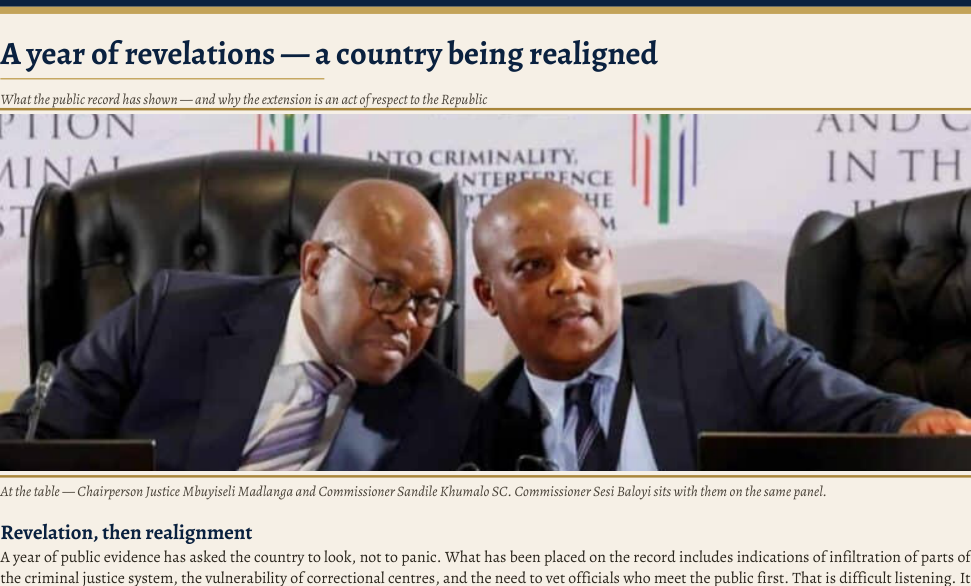
At the table — Chairperson Justice Mbuyiseli Madlanga and Commissioner Sandile Khumalo SC. Commissioner Sesi Baloyi sits with them on the same panel.
Revelation, then realignment
A year of public evidence has asked the country to look, not to panic. What has been placed on the record includes indications of infiltration of parts of the criminal justice system, the vulnerability of correctional centres, and the need to vet officials who meet the public first. That is difficult listening. It is also a form of national self-respect: institutions described in public, so that they can be put back into working order. Chairperson Justice Mbuyiseli Madlanga has said that definitive findings wait for the final report. What the evidence so far shows, in his words, is “indications of serious criminality within the criminal justice system,” arising from infiltration and undue influence. Arrests, suspensions and referrals have followed some of the testimony. Those steps are consequence. They are not the report. Realignment, if it is to mean anything, will be the work that follows the report — policy, oversight and the will to implement what Professor Somadoda Fikeni told the inquiry the country already knows how to write.
The extension, received with respect
The Presidency has given the Commission a final, longer season in which to complete its report. The additional time is to allow further evidence, including expert testimony, to be processed with the care the terms of reference require. The decision is properly received as respect — to the witnesses who have already come forward, to every person whose name has been spoken on the record, and to the public that will have to live with what the report eventually recommends. In this season the National Commissioner of Correctional Services, Makgothi Samuel Thobakgale, took the panel inside the prisons: gangs that groom officials, witnesses who must be protected beyond the walls, the reach of money and influence even toward a national office. Professor Fikeni, chairperson of the Public Service Commission, said South Africa’s difficulty is not a shortage of policy but the will to implement it, and supported the serious vetting of frontline officials. Where a summoned witness was not in the room, and a High Court application was brought against a subpoena and the use of seized messages, the chairperson reserved his ruling. No evidence has yet been given by that witness. The presumption of innocence is undisturbed.
What the extra season is for
Public evidence is due to close so that the record can be written. The Commission’s own account of the year already runs to more than a hundred witnesses, tens of thousands of pages of transcript and more than a hundred thousand pages of documents. A second interim report has already been handed to the President. The extension does not reopen that work for its own sake. It gives the panel time to finish it. Heritage Day and a public inquiry are not at odds. Both ask the same Republic to look at itself without panic, and to put what it finds back into working order. A year of revelations is of use only if the country that heard them is willing to be realigned — carefully, lawfully, and without spectacle.
A note from Neelan Karikan. The extension is a respectful gift to the record. Let the Commission finish the work the country has now given it time to finish.