
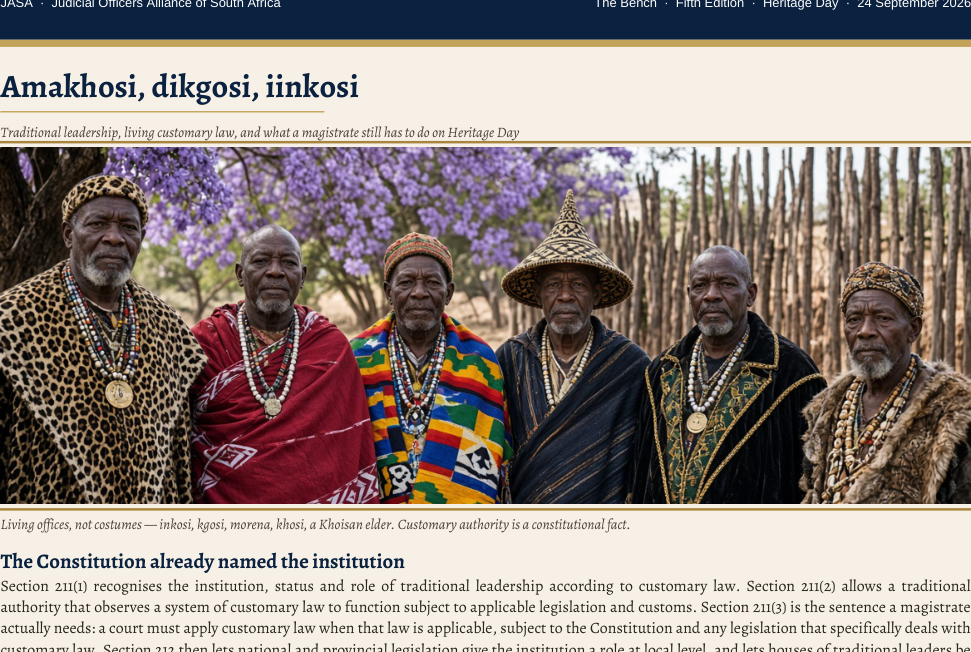
Traditional leadership, living customary law, and what a magistrate still has to do on Heritage Day
Living offices, not costumes — inkosi, kgosi, morena, khosi, a Khoisan elder. Customary authority is a constitutional fact.
The Constitution already named the institution
Section 211(1) recognises the institution, status and role of traditional leadership according to customary law. Section 211(2) allows a traditional authority that observes a system of customary law to function subject to applicable legislation and customs. Section 211(3) is the sentence a magistrate actually needs: a court must apply customary law when that law is applicable, subject to the Constitution and any legislation that specifically deals with customary law. Section 212 then lets national and provincial legislation give the institution a role at local level, and lets houses of traditional leaders be established. That is not Heritage Month colour. It is a working instruction. Zulu, Xhosa, Pedi, Tsonga, Venda, Swati, Ndebele, Basotho, Tswana and Khoi-San communities did not become traditional on 24 September. They were already governing families, land and dispute in living systems the common law spent a long time misdescribing.
The statute that is being rewritten
The Traditional Leadership and Governance Framework Act 41 of 2003 and the National House of Traditional Leaders Act 22 of 2009 remain the older frame. The Traditional and Khoi-San Leadership Act 3 of 2019 tried to consolidate them and, for the first time, to recognise Khoi-San communities and leaders in statute. In Mogale the Constitutional Court held that Parliament had failed in its duty of public involvement and declared the 2019 Act invalid. In Minister of Cooperative Governance and Traditional Affairs v Speaker of the National Assembly [2025] ZACC 22 the Court extended the suspension of that invalidity to 29 May 2027, so that communities are not left without a frame while the Bill is finished. The Traditional and Khoi-San Leadership Bill [B11-2026] was introduced in the National Assembly on 21 April 2026. It would recognise kingships and queenships, traditional and Khoi-San communities, headmanship and headwomanship, councils, houses, and a Commission on Khoi-San Matters. Until it is passed, the magistrate’s duty does not wait. Living customary law, as developed in Bhe v Magistrate, Khayelitsha, Shilubana v Nwamitwa and Alexkor v Richtersveld Mining Co, is already applicable law when the facts call for it.
A working method when a leader walks into the district court
• Do not treat an inkosi, a kgosi or a Khoi-San senior leader as a guest of honour or as a curiosity. They are a constitutional office-bearer. Address the office.
• Recognition disputes, boundary disputes and removal disputes are often not for the district court. Read the Framework Act and the pending Bill before you assume jurisdiction.
• Customary marriage, succession, ukuthwala and lobola are not folklore. They are law. Prove the living custom. Do not import a textbook version that the family in front of you no longer practises.
• Women succeed. Bhe and Shilubana already said so. A rule that erases a daughter because it is “how we have always done it” is not customary law the Constitution will enforce.
• A lekgotla is not a magistrates’ court. If a matter has been heard under custom, write what was decided and what remains for this room. Double punishment is not ubuntu.
A note from Neelan Karikan. Living heritage includes the people who were governing this land before the first district court was built. A Republic that can greet an inkosi and still hear a child in the same week is practising section 211 and section 28 at once. That is the tie that binds us.